
Laughter and Low Vision: How Humor Helps Me Cope and Stay Confident
Let’s be honest—losing your vision isn’t exactly a laugh-a-minute experience. There are days when it’s frustrating, exhausting, and just plain hard. But I’ve learned something along the way: a sense of humor is one of the most powerful tools in my coping kit.
When it comes to adapting to vision loss, I’ve learned that laughter and low vision can absolutely coexist. In fact, a good sense of humor might be one of the most useful tools I have. From spilled drinks to people shouting at me like I’m hard of hearing, I’ve discovered that seeing the funny side of things makes all the difference. It’s not about ignoring the challenges—it’s about facing them with a grin (and maybe a smart remark or two).
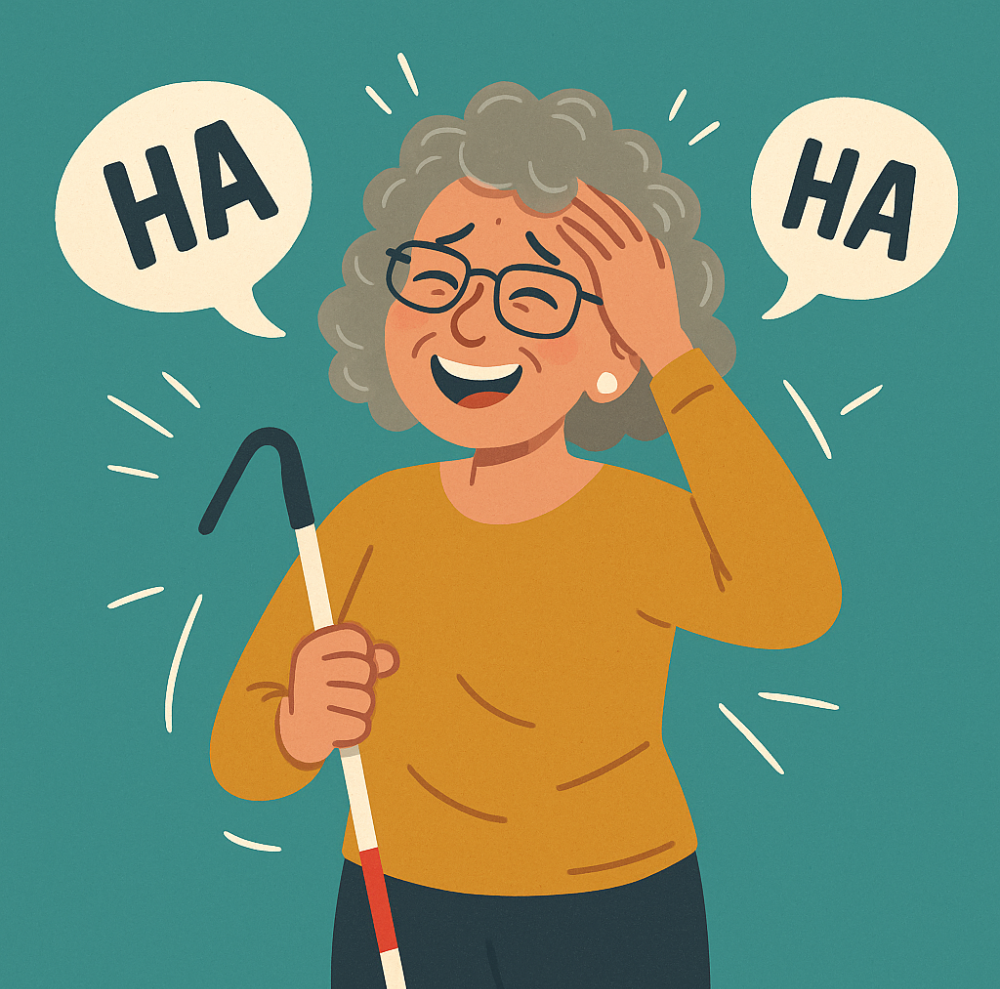 Sometimes the best coping tool is a shared laugh—vision loss doesn’t mean losing your sense of humor.
Humor isn’t just for laughs—it’s good for your health. According to the Mayo Clinic, laughter can relieve stress, improve your mood, and even strengthen your immune system. Turns out, cracking a joke might be one of the healthiest things you can do.
🧭 Reclaiming Control—One Smile at a Time
There’s a real sense of power in being able to laugh, especially at something that could easily make you feel small or discouraged. It shifts the energy.
When someone moves something from its usual spot and I go on a mini treasure hunt through the kitchen, I might call out: “Don’t you know it’s not nice to fool the blind lady?” It makes people laugh—and it gently reminds them that consistency matters in my world.
Or when I knock something over or spill (which happens more often than I’d like to admit), I grin and say, “Well, at least I have an excuse.” It breaks the awkwardness. It tells people (and myself), this isn’t the end of the world.
 Sharing a laugh over dinner—humor helps everyone feel at ease, including the visually impaired loved one at the table.
💬 Laughing With, Not At
Using humor doesn’t mean I don’t take my vision loss seriously. It just means I choose not to let it take over my identity.
I’m still me. And me happens to like jokes, sarcasm, and the occasional eye-roll-worthy one-liner. I’ve just added a few new lines to my routine that fit this phase of life.
For instance, when someone moves something from its usual spot, I’ve been known to say:
“Don’t you know it’s not nice to fool the blind lady?”
Or when someone shouts instructions at me like I’m a half-mile away, I smile and reply:
“I’m blind, not deaf.”
Humor like this might not work in every situation, but when it’s welcome, it can ease tension and bring people closer. As Psychology Today puts it, humor isn’t just a communication tool—it’s a resilience builder.
But here’s the important part: humor is personal. What works for one person—or one family—might feel off-putting to another. In my family, wit and sarcasm are just part of the rhythm. But in public or unfamiliar settings, I read the room. If someone seems uncomfortable or unsure, I might lean into gentle self-deprecating humor or skip it altogether.
The key is knowing your audience—and knowing yourself. Humor should never be a shield or a sharp edge. It should be a bridge. If your version of humor is dry, silly, pun-filled, observational, or just quietly hopeful—that’s valid too.
 “Where did my coffee go?” — A little lighthearted mischief keeps the mood fun and the bonds strong.
SoThe result in my family is that none of us is uncomfortable about my so-called disability. We all accept it as “normal” and in fact, my kids are comfortable picking on me and expect me to pick right back. whether you’re laughing with loved ones or gently easing the tension with strangers, let your humor reflect your voice. Because the real win isn’t the punchline—it’s the connection.
💡 Embracing the Awkward Moments
Let’s face it—this journey is full of awkward. Bumping into things. Asking for help. Having someone explain the color of something you can’t see anymore.
Rather than cringe every time it happens, I try to meet it with grace—and a good-natured quip.
- Someone narrating every detail of a menu I can’t see? “Thanks, but I’m just here for the dessert. That’s where the real decisions are.”
- A stranger offering to help me cross a street I wasn’t planning to cross? “Thanks for the adventure—now, where are we going?”
- Someone hesitating mid-sentence because they’re afraid to say “see” or “look”? “Relax—I still use those words too. I look forward to hearing them.”
When you give others permission to relax, the whole room breathes a little easier.
 Finding the funny in awkward moments—because laughter really is the best way to navigate life’s height (or vision) challenges.
🧠 The Psychology of Humor and Healing
There’s real science behind this. Studies show that laughter can:
- Reduce stress hormones
- Boost endorphins (those feel-good chemicals)
- Help reframe difficult situations
- Strengthen social connection and trust
In other words, a well-timed joke doesn’t just lighten the moment—it helps you physically and emotionally adapt.
I think of humor as my emotional white cane—it doesn’t take the challenge away, but it helps me navigate through it.
🎯 Living Authentically
Here’s what I’ve come to believe: blindness is nothing to hide, apologize for, or feel ashamed of. It’s just part of who I am—like my height or my shoe size. I can’t change it. But I can change how I respond to it.
So I embrace it, quirks and all. I talk about it. I laugh about it. And I build a life that says, “It’s okay.”
Because it is.
 Embracing the moment — because living authentically means letting the light in, even when the path looks a little uncertain.
🌟 What I’ve Learned
Humor isn’t a mask—it’s a mirror. It reflects back strength, resilience, and the spark that vision loss can’t dim.
So, whether it’s a sarcastic one-liner, a good belly laugh over spilled soup, or a quiet smirk after someone calls me “inspirational” for walking to the mailbox—I’ll take it.
Because laughter isn’t just healing—it’s freeing.
And in this journey, we could all benefit from a good laugh, a kind heart, and the reminder that it’s okay not to be perfect.